

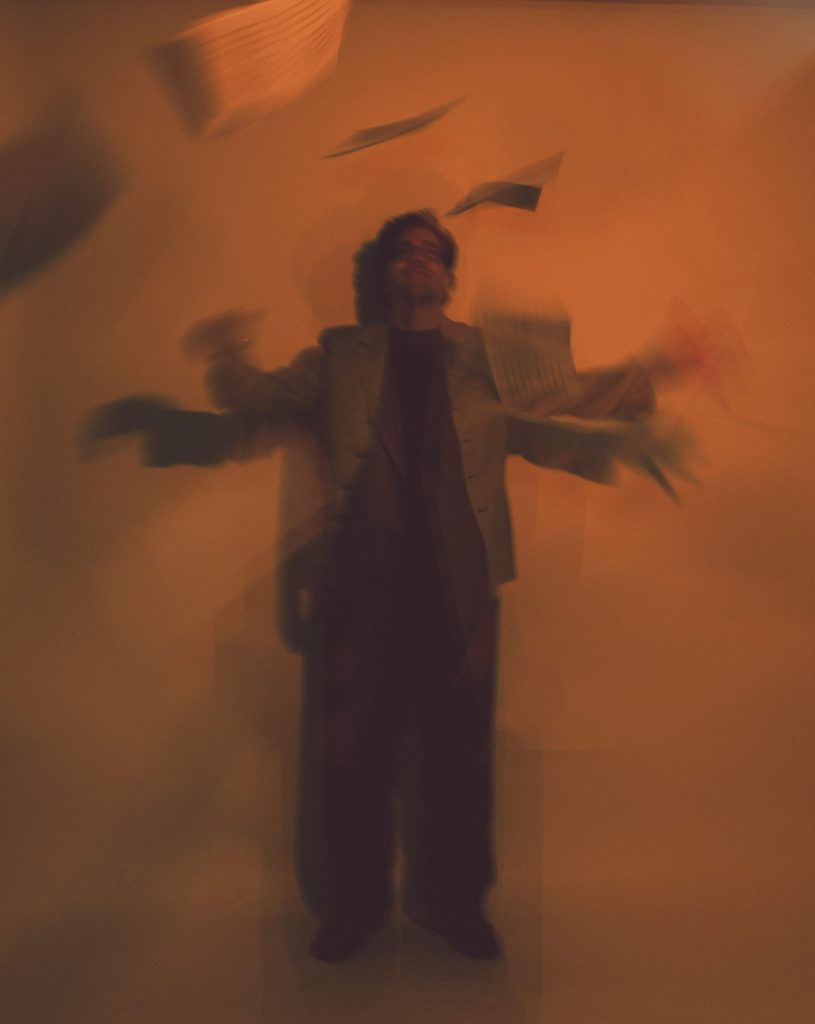
London and Zürich-based artist Lucas F. Jordan is a flutist, composer, and producer whose work bridges diverse worlds. Raised across Brazil, the USA, Switzerland, and the UK, Jordan’s compositions are deeply influenced by an immigrant sensibility—the experience of navigating multiple cultures and never fully belonging to one place. His recent single, “À Procura,” exemplifies this, evolving from a spontaneous creative impulse into a universal exploration of shared humanity. By collaborating with Catalan and Lebanese artists, Jordan shifted the project’s focus from a conventional love song to a broader musical journey, reflecting his core artistic philosophy: a refusal to treat classical music as a static museum piece.
The Intersection of Culture and Composition
When asked if his extensive cultural movement pulls his music in different directions, Jordan explains that he has found a sense of unity in his “in-betweenness.” For a long time, music served as a tether to his Brazilian roots, but as he spent more time abroad, his interests expanded to include everything from Kabuki theatre to Indian Classical music and the sounds of the Balkans. He notes that he has discovered common threads connecting these disparate cultures, leading him to believe that musical borders should be approached with curiosity rather than rigidity.
The creation of “À Procura” was a testament to this collaborative spirit. What began as a simple chord progression at the Abbey Road Institute transformed through the influence of Catalan singer Marti Canales and Lebanese artist Lorette Helou. By integrating Arabic vocal phrases, the track evolved into something far more profound than a standard love song, demonstrating Jordan’s ability to turn happy accidents into cohesive, meaningful art.
Redefining the Classical Landscape
Despite his rigorous training at the Royal Academy of Music and the Zurich University of the Arts, Jordan remains critical of how modern institutions prepare students for the realities of the industry. He argues that classical music has become overly focused on technical perfection at the expense of human expression. For Jordan, the flute—humanity’s oldest instrument—serves as his “mother tongue,” offering a vessel for existential exploration that transcends genre boundaries.
Jordan emphasizes that his goal is to reconnect classical music to the world, moving away from the intellectual pedestal it has been placed upon. He recalls the advice of his mentor, William Bennett, who encouraged him to look beyond the classroom to find true musicianship. “Practice one hour less a day and go for a walk, read a book, look at a painting, go out into the world and experience life instead—that’s what makes a musician,” Jordan reflects. Ultimately, for this artist, music is not just a profession; it is a universal language that provides a sense of home, regardless of where he is in the world.